Comparative and superlative adverbs play a vital role in describing how actions differ in degree or intensity. Whether you are saying someone runs faster or a team works most efficiently, adverbs help measure comparison clearly. This detailed guide from CodeLucky.com explains rules, patterns, and examples to help you master comparative and superlative adverbs with ease.
1. Understanding Adverbs
An adverb modifies a verb, an adjective, or another adverb. It often answers questions like how, when, where, and to what extent. For example:
- She ran quickly. (How did she run?)
- He arrived early. (When did he arrive?)
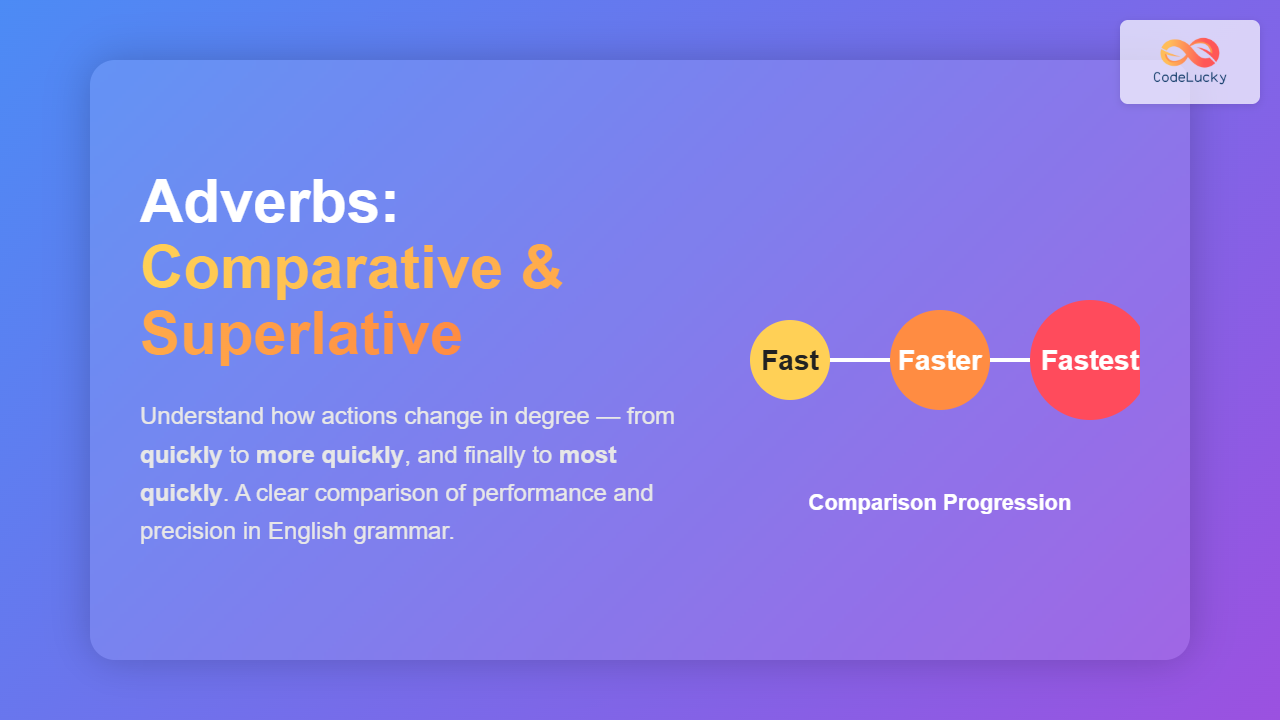
Adverbs can change form to compare actions. When comparing two actions, we use a comparative adverb; when comparing more than two, we use a superlative adverb.

2. Comparative Adverbs
Comparative adverbs are used to show how one action differs from another. They usually end with -er or use the word more before the adverb.
Formation Rules:
- For short adverbs (one syllable), add -er.
Example: fast → faster - For longer adverbs, use more + adverb.
Example: carefully → more carefully - Some adverbs are irregular and have special forms.
Example: well → better
| Base Adverb | Comparative Form | Example |
|---|---|---|
| fast | faster | She runs faster than her brother. |
| carefully | more carefully | He checks the reports more carefully than before. |
| well | better | They perform better under pressure. |

3. Superlative Adverbs
Superlative adverbs show that an action is performed to the highest or lowest degree among three or more actions. Their forms usually end in -est or use most before the adverb.
Formation Rules:
- For short adverbs, add -est. Example: fast → fastest
- For longer adverbs, use most + adverb. Example: carefully → most carefully
- Irregular forms remain unique. Example: well → best
| Base Adverb | Superlative Form | Example |
|---|---|---|
| fast | fastest | She ran the fastest in the competition. |
| carefully | most carefully | He painted the picture most carefully. |
| well | best | That team performed the best. |

4. Irregular Adverbs List
Some adverbs do not follow standard rules. Memorizing them helps in daily communication.
| Base Form | Comparative Form | Superlative Form | Example Sentence |
|---|---|---|---|
| well | better | best | She plays better than me, but he plays best of all. |
| badly | worse | worst | He performed worse yesterday, but that was his worst game ever. |
| little | less | least | She worked less today, but least during holidays. |
| far | farther/further | farthest/furthest | They traveled farther than us, but that was their farthest trip. |
5. Quick Visual Summary

6. Interactive Practice Exercise
Try this quick self-check:
- She drives ______ than before. (fast)
- He speaks ______ of all. (clearly)
- This student studies ______ than the others. (hard)
Answers (Click to reveal)
Show Answers
- faster
- most clearly
- harder
7. Common Mistakes to Avoid
- Do not use both ‘more’ and ‘-er’ together (Incorrect: more faster → Correct: faster).
- Avoid double comparatives (e.g., “betterer” is incorrect).
- Remember to use “the” before superlative adverbs (e.g., She runs the fastest).
8. Conclusion
Comparative and superlative adverbs make sentences more meaningful by showing how actions differ in level or quality. Whether comparing two actions or highlighting the best among many, understanding these forms helps express precision and fluency in English communication.
Practice using adverbs daily to enhance clarity and confidence in both writing and speaking.