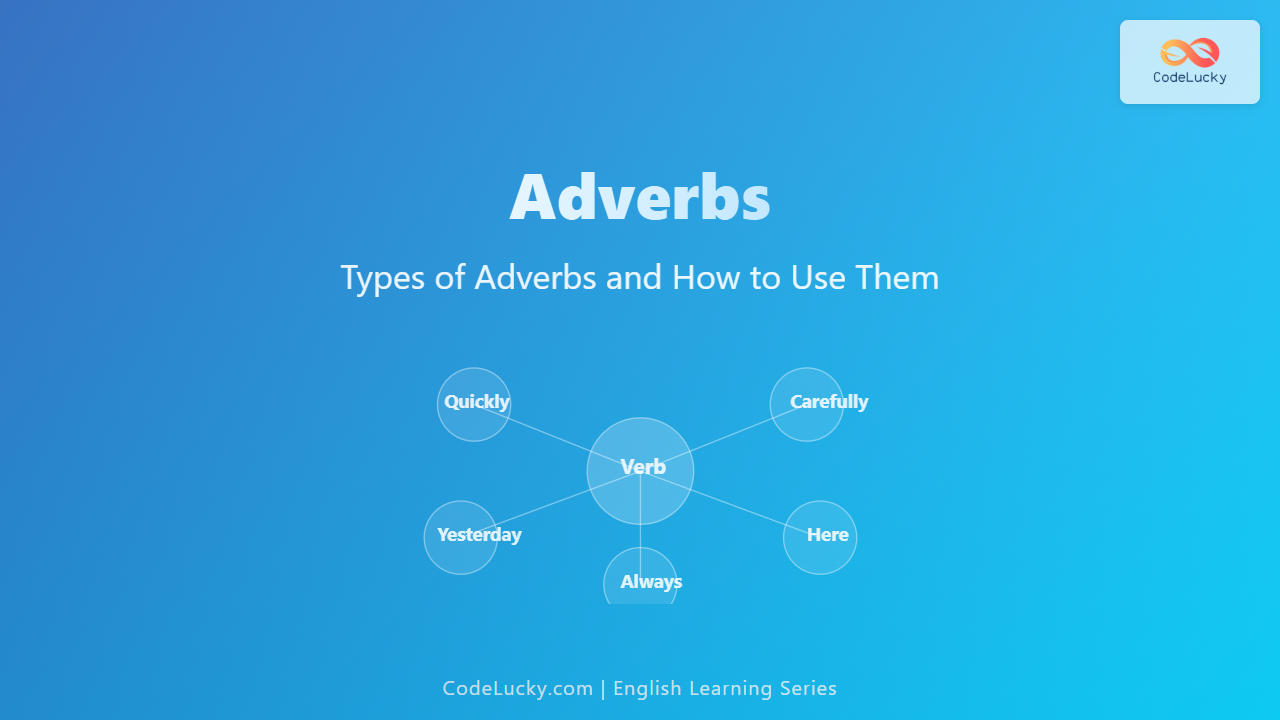
Adverbs are a crucial part of English grammar that help add depth and meaning to sentences. They describe or modify verbs, adjectives, or even other adverbs, telling us how, when, where, or to what extent something happens. In this detailed guide by CodeLucky.com, we’ll explore every type of adverb, with examples, visual explanations, and simple interactive exercises to help you master their use.
What is an Adverb?
An adverb modifies a verb, adjective, or another adverb. It helps to express details such as manner, time, frequency, degree, or place.
Examples:
- She speaks softly. (modifies verb speaks)
- This book is very interesting. (modifies adjective interesting)
- He ran quite quickly. (modifies adverb quickly)

Main Types of Adverbs
Adverbs fall into several categories based on what kind of information they provide. Let’s go through each one with examples and guidance.
1. Adverbs of Manner
They describe how an action is performed. Often end in -ly.
Examples:
- She danced gracefully.
- They worked carefully on the project.
- He shouted angrily at the opponent.

Tip: Place adverbs of manner after the verb or after the object.
She wrote neatly. ✅
She neatly wrote. ❌ (less common)
2. Adverbs of Time
These adverbs tell us when something happens.
Examples:
- We’ll meet tomorrow.
- I haven’t eaten yet.
- She arrived early.

Usage Tip: They appear at the beginning or end of a sentence.
Yesterday, I watched a movie. ✅
I watched a movie yesterday. ✅
3. Adverbs of Place
They specify where an action occurs.
- He’s waiting outside.
- Please sit here.
- They looked everywhere for the key.

Usage Example:
The kids are playing outside.
4. Adverbs of Frequency
They describe how often something happens.
- I always wake up early.
- He rarely drinks coffee.
- We sometimes go out on weekends.

Placement Rule: Usually placed before the main verb but after “to be”.
She is always happy. ✅
She always eats breakfast. ✅
5. Adverbs of Degree
They show how much or to what extent.
- I’m totally ready.
- This problem is quite difficult.
- He’s too tired to walk.

Tip: Common intensifiers like “very” or “extremely” amplify meaning, while words like “slightly” or “barely” reduce intensity.
Position of Adverbs in Sentences
The meaning of a sentence can change depending on the placement of an adverb. The general rules are:
- Front position: Before the subject – usually for emphasis.
- Mid position: After the subject but before the main verb.
- End position: After the verb or object.
Quickly, she packed her bags. (Front)
She quickly packed her bags. (Mid)
She packed her bags quickly. (End)
Interactive Practice (Try it!)
Choose the correct adverb placement in each sentence:
- (Always / He / is) late for meetings. → He is always late for meetings.
- (Carefully / She / drives) to work. → She drives carefully to work.
- (Tomorrow / We / will go) shopping. → We will go shopping tomorrow.
Common Mistakes with Adverbs
- Don’t confuse adjectives with adverbs. For example, “She sings beautifully” (not “beautiful”).
- Avoid double negatives with adverbs of frequency like “never”.
- Remember that some words serve both roles: “fast”, “hard”, “late”.
Summary Table: Types of Adverbs
| Type | Answers | Examples |
|---|---|---|
| Manner | How? | Quickly, slowly, bravely |
| Time | When? | Yesterday, soon, daily |
| Place | Where? | Here, there, nearby |
| Frequency | How often? | Always, often, rarely |
| Degree | To what extent? | Very, almost, completely |
Conclusion
Adverbs may seem small, but their impact on clarity and tone in English communication is huge. By understanding the types and correct placement, you can make your writing sound natural and expressive. Practice frequently with short sentences and soon using adverbs will feel intuitive. Continue exploring English grammar guides at CodeLucky.com for your next learning step!