Adjectives bring color, size, and character to nouns. But what happens when you use multiple adjectives together — like a beautiful small round wooden table? The challenge is knowing which adjective comes first. This article from CodeLucky.com carefully explains the order of adjectives in English sentences with examples, visual charts, and interactive notes to help you master it like a pro.
What Are Adjectives?
Adjectives describe or modify nouns and pronouns. They tell us more about qualities, quantities, colors, opinions, and other details. Examples include: red, beautiful, tall, wooden, five.
Example:
The tall man — “tall” is an adjective describing the man.
The Standard Order of Adjectives in English
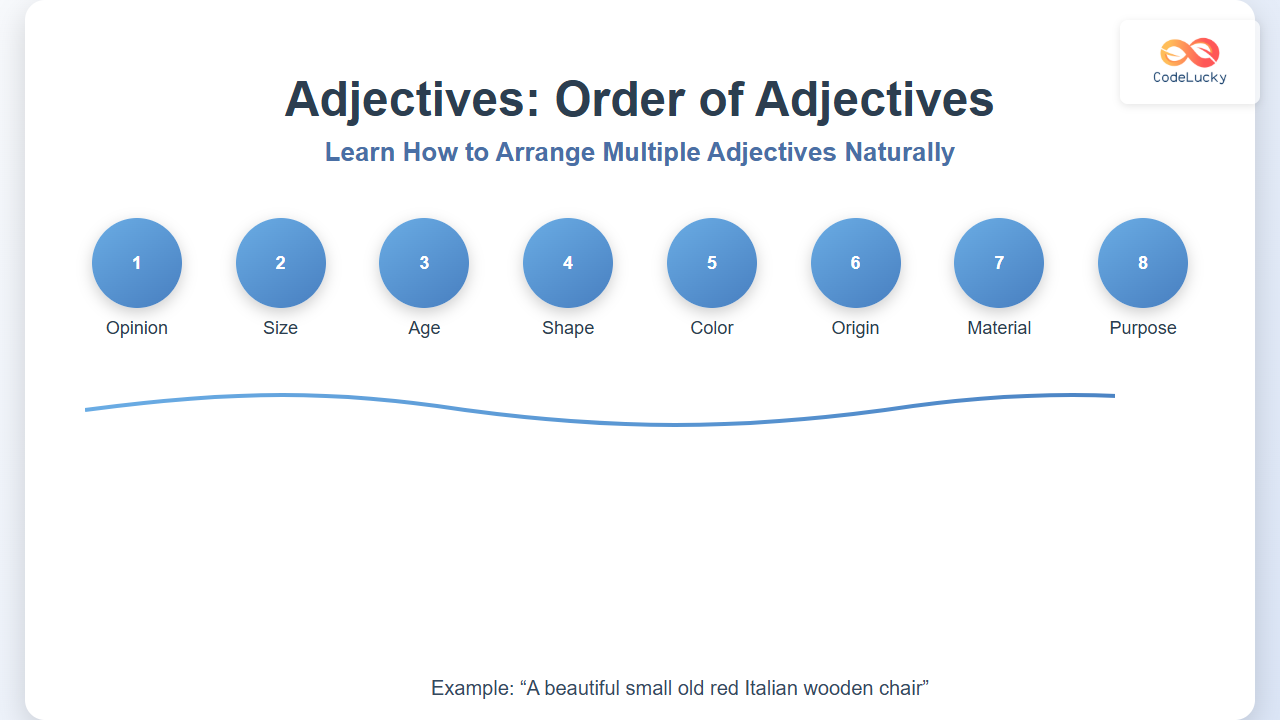
When several adjectives modify a single noun, they follow a particular sequence in natural English. Although native speakers do this intuitively, learners need a clear formula. Here’s the general order:
- Determiner (a, an, the, some, this, my)
- Opinion (beautiful, ugly, nice, wonderful)
- Size (big, small, tall, huge)
- Age (new, old, young, modern)
- Shape (round, square, oval, rectangular)
- Color (red, blue, green, black)
- Origin (Indian, French, American, Chinese)
- Material (wooden, metal, silk, cotton)
- Purpose or qualifier (cooking pot, racing car, sleeping bag)
This can be remembered with a simple pattern cue:
DOASCOMP (Determiner → Opinion → Age → Size → Color → Origin → Material → Purpose)
Visual Representation
Examples of Correct Adjective Order
Example 1:
A beautiful small round wooden table
→ Opinion: beautiful | Size: small | Shape: round | Material: wooden | Noun: table
Example 2:
An old Italian leather bag
→ Age: old | Origin: Italian | Material: leather | Noun: bag
Example 3:
That large new blue car
→ Size: large | Age: new | Color: blue | Noun: car
Incorrect Example (and why):
A wooden round beautiful table ❌
The order feels unnatural because “beautiful” (opinion) should come before “size” or “shape”, not after material.
Quick Practical Rule
If you’re unsure — place adjectives that express personal feelings (opinion) before more objective ones (size, shape, color, material). For example:
A lovely green dress ✅ vs A green lovely dress ❌

Interactive Practice
Try to arrange the following adjectives into the correct order before revealing the correct answer.
1. (beautiful / silk / red / Italian / dress)
Show Answer
✅ A beautiful red Italian silk dress
2. (old / small / wooden / table)
Show Answer
✅ An old small wooden table
3. (round / big / Indian / carpet)
Show Answer
✅ A big round Indian carpet
When Breaking the Rule Is Okay
Sometimes, writers or speakers reorder adjectives for emphasis or poetic effect, especially in creative writing or marketing.
Example:
The golden old days (commonly used phrase putting “golden” before “old” for poetic sound)
However, in formal writing or exams, always follow the standard adjective sequence.
Mermaid Diagram of Adjective Grouping by Function

Common Mistakes to Avoid
- Placing material before color (e.g., a silk red dress ❌).
- Mixing opinion after factual adjectives (e.g., a red beautiful rose ❌).
- Forgetting determiners like a, the, my.
- Adding too many adjectives — sometimes less is more.
Adjective Order Shortcut Table
| Category | Examples | Position |
|---|---|---|
| Determiner | a, an, the, some, this | 1st |
| Opinion | beautiful, wonderful, lovely | 2nd |
| Size | big, small, tiny | 3rd |
| Age | old, new, young | 4th |
| Shape | round, square | 5th |
| Color | red, black, blue | 6th |
| Origin | Indian, French | 7th |
| Material | wooden, metal, cotton | 8th |
| Purpose | racing (car), sleeping (bag) | 9th |
Final Example Summary
A charming little old white French ceramic coffee mug
→ Determiner: A
Opinion: charming
Size: little
Age: old
Color: white
Origin: French
Material: ceramic
Purpose: coffee
Noun: mug
Conclusion
Mastering the order of adjectives helps you sound more fluent and natural in English communication. By thinking about meaning groups — feeling (opinion), size and shape (appearance), factual detail (origin, material, purpose) — you can arrange adjectives smoothly. Keep practicing with real examples, and soon, your sentences will sound perfectly structured and naturally English.