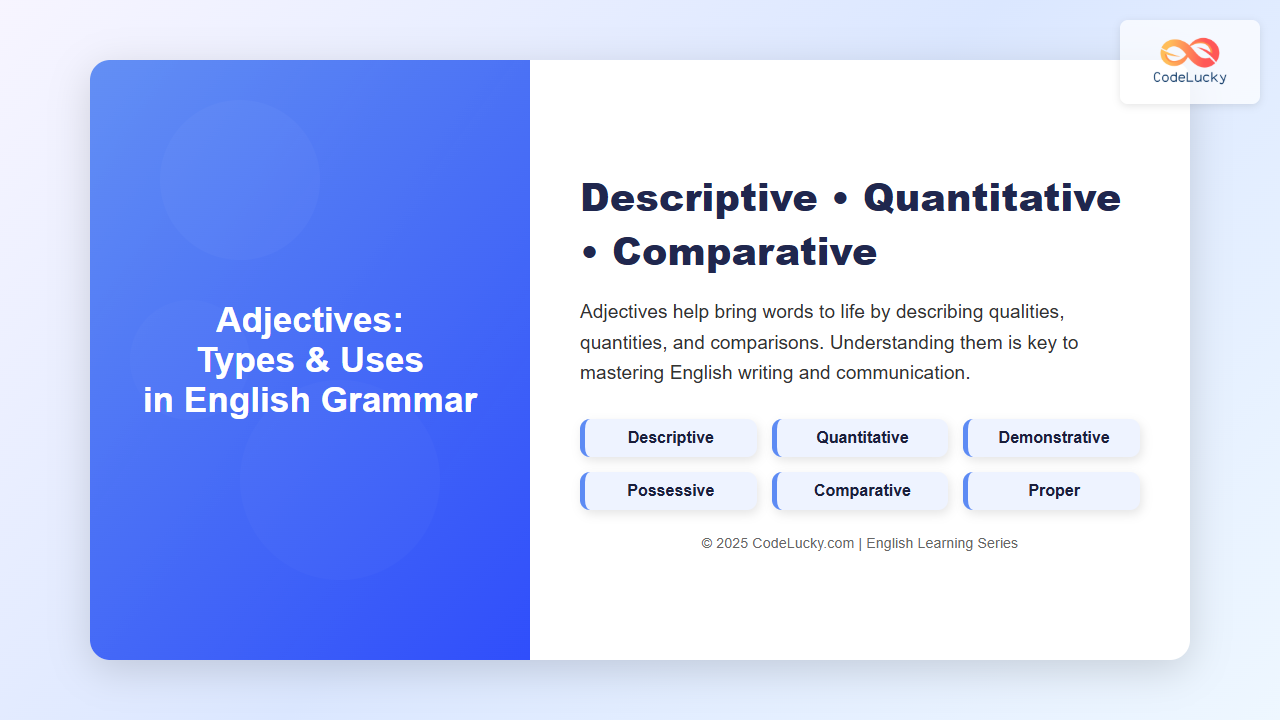
Adjectives are one of the most important parts of speech in the English language. They add color, depth, and meaning to nouns and pronouns, helping us describe things more vividly. Without adjectives, our language would sound dull and lifeless. Understanding their types and correct usage can take your English writing and speaking skills to the next level.
What Is an Adjective?
An adjective is a word that describes or modifies a noun or pronoun. It tells more about its quality, quantity, number, size, shape, color, or condition.
Example:
- The beautiful garden is full of colorful flowers.
- She has a large house on the quiet street.
Here, “beautiful,” “colorful,” “large,” and “quiet” give us extra information about nouns (garden, flowers, house, street).
Main Types of Adjectives with Examples
Adjectives can be classified into several types based on how they describe or define a noun. Let’s explore each type with examples and visual representation.
1. Descriptive Adjectives
These adjectives describe the qualities, features, or characteristics of a noun.
Examples:
- A tall man walked into the room.
- It was a cold morning.
Descriptive adjectives answer “What kind?” or “How is it?”

2. Quantitative Adjectives
These show how much or how many of something there is.
- I have some money.
- He drank little water.
- We bought five apples.
Quantitative adjectives answer “How much?” or “How many?”
3. Demonstrative Adjectives
They indicate specific nouns and tell which one is being referred to.
- This book is interesting.
- Those cars are expensive.
- That house belongs to my uncle.

4. Possessive Adjectives
These adjectives show possession or ownership.
- My phone is on the table.
- Their teacher is very kind.
- Our school won the competition.
Common possessive adjectives: my, your, his, her, its, our, their.
5. Interrogative Adjectives
They are used to ask questions and are followed by nouns.
- Which color do you prefer?
- What time is it?
- Whose pen is this?
6. Distributive Adjectives
Used to refer to people or things one at a time.
- Each student must submit homework.
- Either route leads to the station.
- Every child deserves education.
7. Proper Adjectives
Derived from proper nouns and usually begin with a capital letter.
- Indian food is spicy.
- American cars are very durable.
- Shakespearean plays are timeless.

8. Compound Adjectives
These are adjectives made up of two or more words joined by a hyphen.
- A well-known author visited the school.
- She wore a full-length dress.
- The test is open-book.
9. Comparative and Superlative Adjectives
To show comparison, adjectives change their form:
| Degree | Example |
|---|---|
| Positive | Fast |
| Comparative | Faster |
| Superlative | Fastest |
Position of Adjectives in a Sentence
Adjectives usually come before the noun they describe, but sometimes they appear after linking verbs like “is,” “seems,” or “becomes.”
Examples:
- Before noun: A red car is parked outside.
- After linking verb: The car is red.
Order of Multiple Adjectives
When multiple adjectives are used before a noun, they generally follow this order:
- Determiner
- Opinion
- Size
- Age
- Shape
- Color
- Origin
- Material
- Purpose
Example: She bought a beautiful small old round red Italian wooden writing table.

Interactive Mini-Practice: Identify the Adjective
Try to find the adjectives in the following sentences:
- The busy market was full of noise.
- He bought three delicious mangoes.
- That tall man is my uncle.
👉 Answers: (1) busy, (2) three, delicious, (3) that, tall.
Conclusion
Adjectives breathe life into language. Whether they describe appearance, quantity, ownership, or comparison, their correct use transforms plain sentences into engaging expressions. To master English writing, practice identifying and experimenting with different types of adjectives in your own sentences.
Pro Tip: While writing or speaking, ask “What kind?”, “Which one?”, or “How many?” to easily spot where adjectives fit naturally!