Writing clear and effective English often comes down to one thing — using the active voice. Whether you’re writing an email, article, or academic report, mastering active sentences will make your writing stronger and more direct. This detailed guide explains what active voice is, how to use it, and when to prefer it over the passive voice — with examples and visual diagrams to make understanding effortless.
What Is Active Voice?
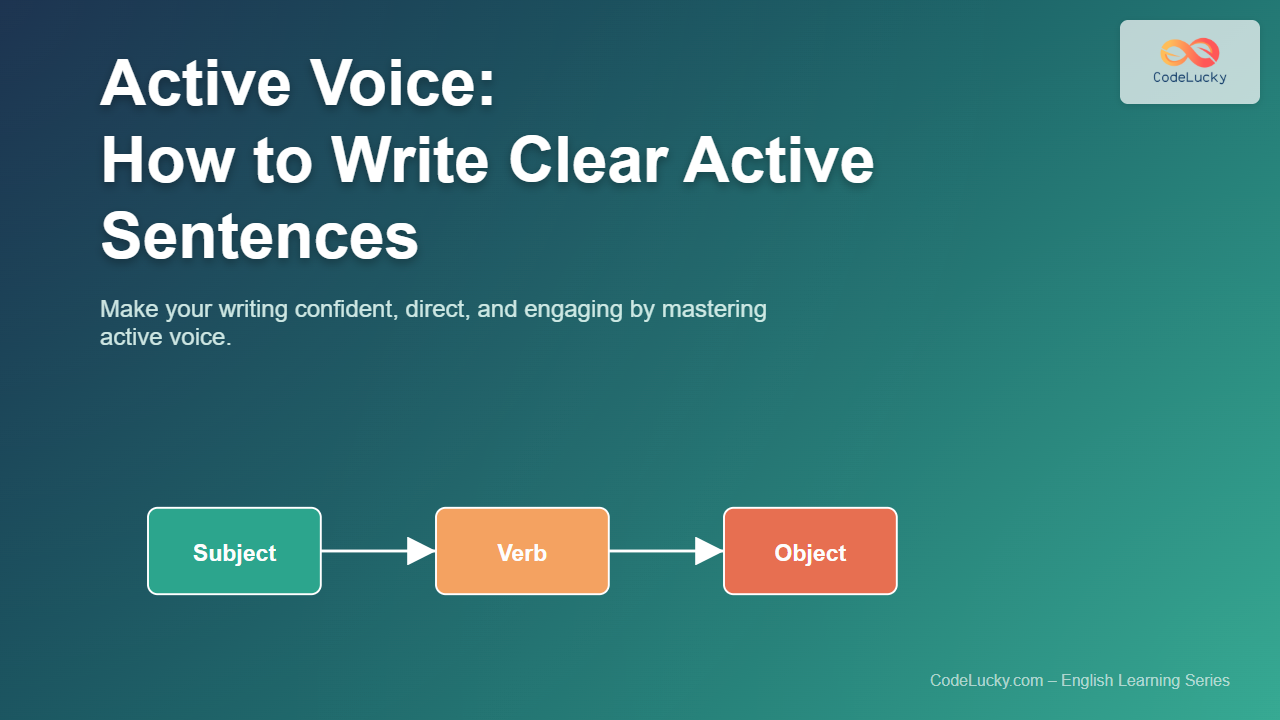
In active voice, the subject of a sentence performs the action. The structure follows a simple and logical order: Subject → Verb → Object.
Example: Ravi repaired the laptop.
Here, Ravi (subject) performs the action of repairing (verb) on the laptop (object).
Visualized, it looks like this:

Active vs. Passive Voice
In passive voice, the subject receives the action rather than doing it. Let’s look at the same example in both forms:
- Active: Ravi repaired the laptop.
- Passive: The laptop was repaired by Ravi.
The active voice highlights who is doing the action, while the passive focuses on the receiver of the action. In most writing, especially business, technical, and instructional materials, the active voice creates more impact and clarity.

Why Use Active Voice?
Using active voice enhances readability and confidence in writing. It’s the preferred style in most professional and academic settings because of these advantages:
- Clarity: Makes it clear who performs the action.
- Conciseness: Fewer words and less complexity.
- Engagement: Keeps the reader’s attention on action.
- Confidence: Projects authority and directness.
How to Identify Active Voice
Ask these three quick questions about a sentence:
- Who is the main actor (subject)?
- What action is happening (verb)?
- Who or what receives the action (object)?
If the subject clearly performs the action, it’s an active sentence.
Try identifying it visually:

When to Use Passive Voice Instead
Although the active voice is usually preferred, the passive voice is sometimes useful — especially when:
- The actor is unknown or irrelevant. Example: The window was broken.
- The receiver of the action is more important. Example: Safety rules were introduced.
- The focus should be on the result rather than the actor, such as in scientific writing.
Transforming Passive Sentences into Active Ones
Let’s practice converting passive sentences into active voice. Here are some examples:
| Passive Voice | Active Voice |
|---|---|
| The report was written by Meera. | Meera wrote the report. |
| The project was completed by the team. | The team completed the project. |
| The invitation was sent by Arjun. | Arjun sent the invitation. |
Notice how the active versions feel stronger and more natural to read.
Formula for Active Sentence Construction
Use this formula to frame any active sentence:

For example: Teacher (S) explained (V) the topic (O).
Tips for Writing in Active Voice
- Always identify the subject first — the “doer.”
- If you see “by” followed by a noun, it’s likely passive; try reworking it.
- Use dynamic verbs instead of forms of “to be” (is, was, were).
- Read sentences aloud — passive ones often sound indirect or formal.
Interactive Mini Exercise
Convert the following sentences to active voice mentally or in your notebook:
- The email was written by the manager.
- The menu was designed by the chef.
- The film was directed by Christopher Nolan.
- The package was delivered by the courier.
Show Answers
- The manager wrote the email.
- The chef designed the menu.
- Christopher Nolan directed the film.
- The courier delivered the package.
Visual Summary
Conclusion
Active voice is the backbone of strong and clear English writing. It helps you write confidently, communicate efficiently, and maintain the reader’s engagement. Once you start noticing passive constructions, you’ll naturally shift toward active, powerful expression in everything you write — from short messages to long essays.
Practice this skill regularly, and soon, writing in active voice will become second nature.